
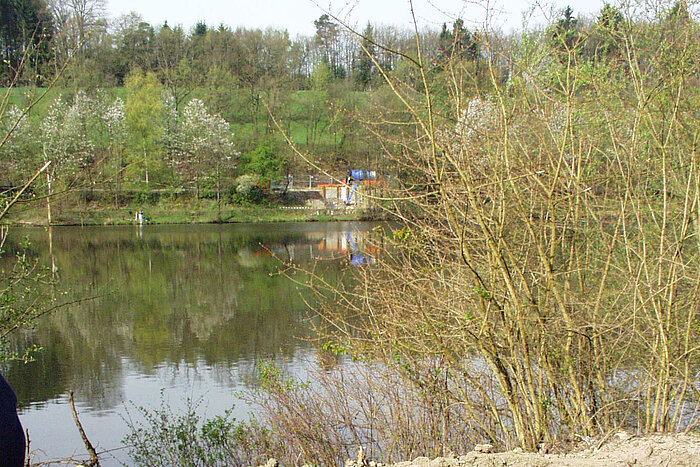
When Kreiswerke Olpe identified losses in the pipework network at a twin inverted siphon in the area of the Biggesee forebay in 2003, they were faced with a far-reaching decision: new construction, replacement or rehabilitation? The two parallel drinking water pipes, dating from 1965, run for a length of around 200 metres across the bed of a forebay of the reservoir and supply the Drolshagen city area. After the engineering firm Bieske und Partner GmbH had assessed the alternatives, Kreiswerke Olpe (KWO) opted in 2004 for the Primus Line® technology, which was still in its infancy at the time. More than two decades have passed since the rehabilitation, and the pipeline has been reliably supplying local residents with drinking water. Uwe Axt, a water supply engineer at Kreiswerke Olpe, for whom this project was one of the first he managed independently, recalls the decision and its implementation.
· Long-term reference
Initial situation, decision and implementation
The engineering firm commissioned by KWO quickly ruled out building a new pipeline or replacing the defective feeder pipeline using open-cut construction methods. As the forebay and the drinking water pipeline were constructed as part of the new dam, the two parallel drinking water pipelines lie approximately 1.50 metres below the base of the forebay, in a pipe trench dug specifically for this purpose. Over the years, sediment had also accumulated in the forebay.
To replace the pipe, the sludge would have had to be dredged or relocated. This would have entailed high transport and disposal costs. On the recommendation of the engineering firm, KWO opted for the rehabilitation of the twin inverted siphon.
When selecting the rehabilitation method, the operator had defined the following requirements:
- A minimum cross-section of 200 millimetres in the pipes was to be maintained so as not to reduce the hydraulic capacity.
- It should be possible to pass through the two 30° bends along the course of the inverted siphon.
- It was essential to ensure a pressure rating of 16 bar.
Primus Line® technology met all the specified requirements: the flexible liner was able to pass through the bends and, thanks to its thin wall thickness of six millimetres, barely reduced the pipe’s cross-section. The required pressure rating was also maintained.
Another key advantage of the new technology was the short construction time: the rehabilitation of the twin inverted siphon took just four days. The liner installation itself lasted only 45 minutes per inverted siphon section. Once the connectors had been fitted, pressure testing, disinfection and reconnection to the supply network were carried out.
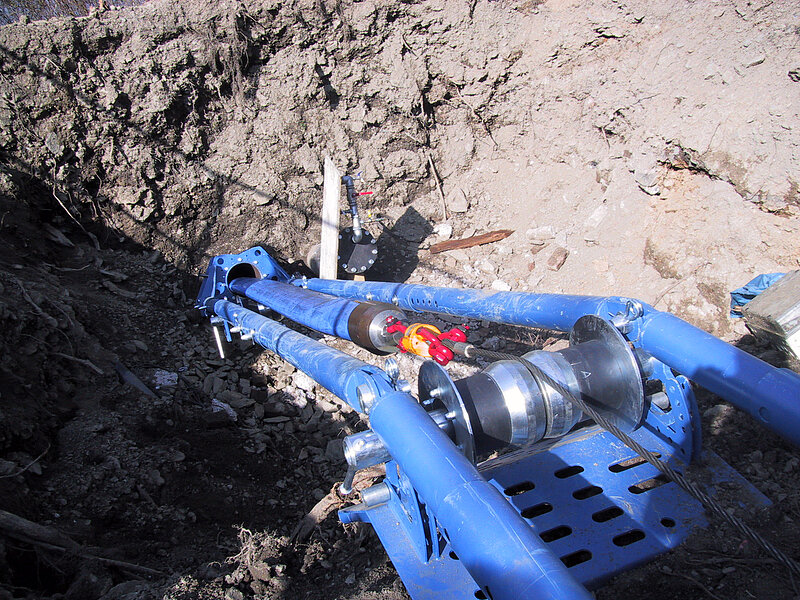
A distinctive feature of the project was the inclusion of a control cable within one of the inverted siphon sections. At the time, it was bonded to the liner and pulled in with it. As the control cable could not be pulled through the connector due to the tensile-resistant and watertight joint, it was routed out via a side outlet. This is where it differs from today’s practice: back then, the liner was still flat, whereas today it is folded into a U-shape; additional cables, such as control or fibre-optic cables, are inserted directly into the fold to avoid unnecessary steps during insertion.
In parallel with the pipe rehabilitation, the first step involved demolishing the technically obsolete manhole structures and rebuilding them after the liners had been pulled in. This ensured optimal access to the inverted siphon branches.
According to estimates at the time by the operator and the engineering firm, the costs resulting from the use of the new Primus Line® technology were around 70 per cent lower than those of the assessed alternative solutions. These would have involved rerouting the pipeline or constructing a new twin inverted siphon. The client’s decision in favour of Primus Line® was therefore primarily based on economic and technical grounds.
„The company doesn’t just supply a product, but works in a solution-oriented manner and provides the technology necessary to implement the project.“
Uwe Axt | Water Supplyy Engineer at Kreiswerke Olpe
Operator’s perspective: Three questions for Uwe Axt
More than two decades later, the rehabilitation of the twin inverted siphon at the Biggesee is not only an example of the early use of trenchless technologies in drinking water supply. It also illustrates the factors that operators had to weigh up when deciding on a solution that was still novel at the time. Uwe Axt reflects as follows on the decision-making process, the challenges on site and his experiences with Rädlinger Primus Line technology:
Mr Axt, what were the reasons behind KWO’s decision to opt for a rehabilitation using Primus Line®? Was it purely down to the cost savings?
I had already researched trenchless rehabilitation methods and had come across the Primus Line® technology which was still in its infancy at the time. The structure of the liner, with its Kevlar® reinforcement and inner and outer layers of plastic, and the resulting properties had convinced me: the liner is both flexible and stable.
We were aware that the product was very new. However, the twin inverted siphon requiring rehabilitation, at 200 metres per branch, was of a manageable length. And in terms of its bend-traversing capability and minimal reduction in cross-sectional area, we had virtually no alternatives. Rehabilitation using a PE pipe, for example, would have reduced the diameter too much.
What challenges did you face at the time?
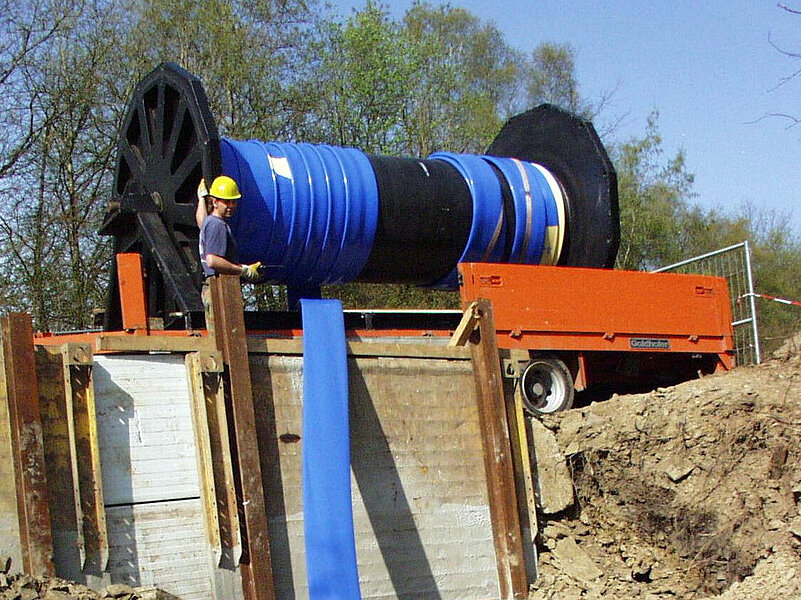
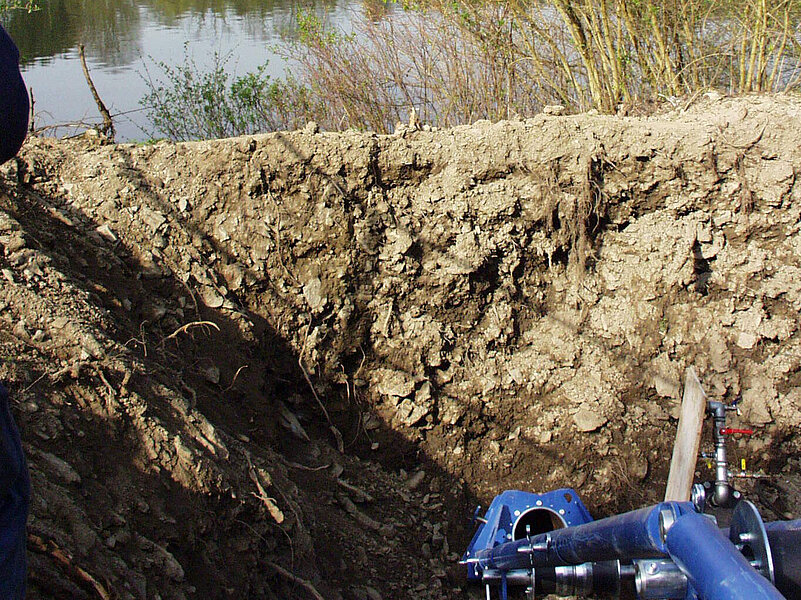
As the pipe ends prepared for the liner’s insertion were located directly on the lakeshore, the available working areas on both sides of the lake were very limited by a main road and a railway line. The reel on which the liner was delivered stood six metres above the insertion point and was directly adjacent to the railway line. The excavation pit beneath the reel was secured using shoring elements. To ensure that the liner was not damaged by stones and the underlying bedrock as it was pulled from the reel into the host pipe, we had lined the excavation pit with pallets. Guide rollers were fitted to the host pipe to prevent friction against its cut surface.
After cleaning the pipe sections to be rehabilitated, it was found that groundwater was seeping into the pipes from outside. To ensure that the specified pulling forces were not exceeded during the insertion of the liner, the ingressing water was removed using a pig shortly before insertion, and the liner was then inserted immediately afterwards.
This trenchless method requires a pulling winch to pull in the liner. To minimise the pulling forces to a maximum of 2.5 tonnes and to bridge the difference in height between the pulling winch and the host pipe, the fitters from Rädlinger Primus Line installed a system of deflection pulleys through which they guided the winch cable. The guide system could be flexibly adapted to the conditions of the excavation pit.
These are just three examples of pragmatic solutions. They have shown me that we had commissioned a company whose staff possess engineering and civil engineering expertise.
What is your personal conclusion?
With Rädlinger Primus Line, I got the impression that those in charge had given the matter careful thought and knew what they were doing. This impression has been further reinforced in subsequent projects: the company doesn’t just supply a product, but works in a solution-oriented manner and provides the technology necessary to implement the project.
We’re very pleased about that. Thank you very much for the short interview!
A successful duo
The Biggesee twin inverted siphon is one of four twin inverted siphons falling within the remit of Kreiswerke Olpe. Each of the inverted siphons was constructed as part of a new dam construction project. The twin-tube design ensures that the water supply can be maintained in the event of a failure. Three of the grey-cast iron twin inverted siphons have since been rehabilitated using Primus Line®:
| 2 x 200 m DN 300, pressure rating PN 16 |
| 2 x 280 m DN 350, pressure rating PN 16 |
| 2 x 250 m DN 400, 2 x 250 m DN 350, pressure rating PN 16 |
In addition, following a pipe burst, a section of a drinking water pipeline was rehabilitated using Primus Line®.
| 250 m DN 250, pressure rating PN 16 (one branch only) |
Stay up to date with Primus Line: Subscribe to our newsletter now!
Information about sending newsletters with the provider CleverReach, evaluation, and your unsubscribe options can be found in our privacy policy.